
A specification brief you can send a mill: zone, fibre, construction, dye lot and documents
A useful hospitality or workplace carpet specification names each zone, the fibre and construction proposed for that zone, how colour will be controlled across dye lots, and the documents the mill must return with the quotation — before anyone compares a unit price.
What belongs in the brief before price
A useful hospitality or workplace carpet specification names each zone, the fibre and construction proposed for that zone, how colour will be controlled across dye lots, and the documents the mill must return with the quotation — before anyone compares a unit price.
Record the project type, the delivery country, and who will walk on each area. Say whether the carpet is to be fixed in place or used as a movable piece. For each zone, write the proposed fibre, construction, pile, backing and edge, together with finished dimensions, quantities, pattern direction, the cleaning routine and any building constraints that affect delivery or installation. Ask the mill to return a written response against that same list, including dye-lot control and any performance evidence required for the particular item.
Name the zone, then the fibre and construction
A hotel corridor, a guestroom, a food-and-beverage floor and an open workplace place different demands on the same square metre. The room name alone rarely explains how the floor will be used. Describe the actual rooms, the furniture plans, doorways, transitions to adjacent floors, and the traffic you expect.
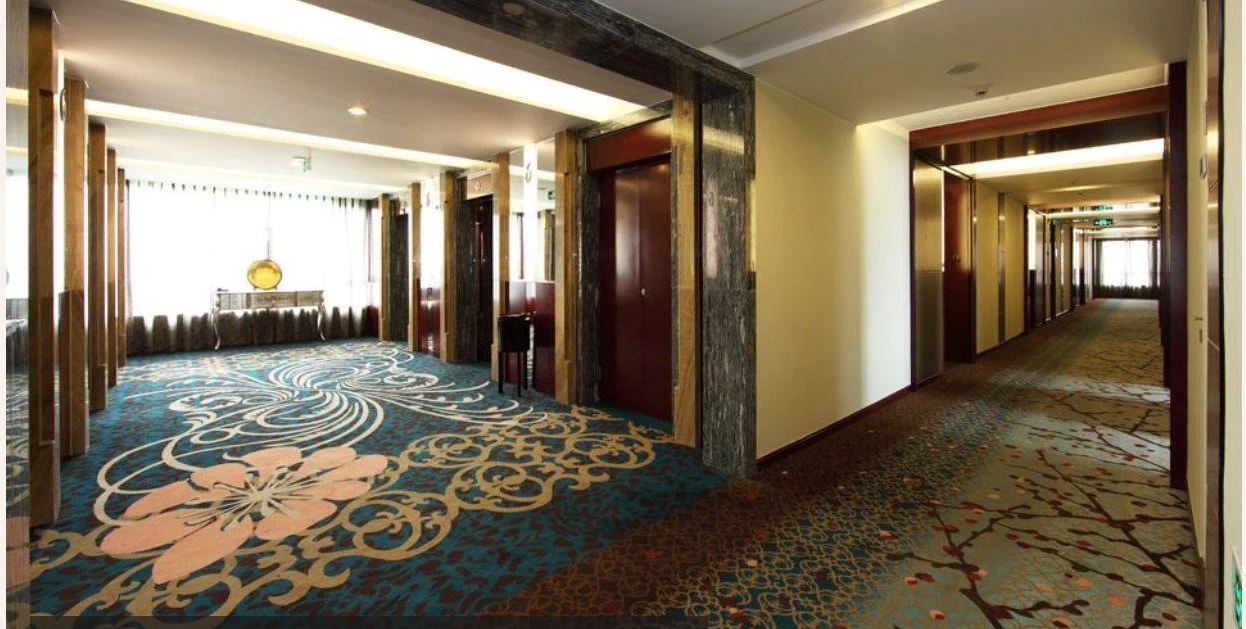
This site publishes hospitality and residential room references that show how different settings read — a circulation floor at DoubleTree by Hilton Wuxi, a lounge and guestroom at Hilton Garden Inn Hengqin, a continuous lounge field at Fairmont Peace Hotel. A photograph illustrates a setting and a carpet relationship. It does not, by itself, settle construction, performance or the scope of a contract; those belong in the brief and in the project record.
ADA describes its English-language offer as a full-category range for hospitality, residence and workplace. The published catalogue is organised in six families: handcrafted rugs, bespoke patterns, creative carpet patterns, woven fibre collections, outdoor weaves and area rug selections. A collection page may show a hand-finished piece or an artwork reference, and those two are not the same thing. Write the construction you actually want, and ask which of the two a given image represents.
When the brief needs a zone-by-zone construction table — corridors, guestrooms, food and beverage, and workplaces — use choose construction and fibre by zone, not by a single unit price. Attach that table after this brief. It uses only the material families already published on this English site, and it marks what must still be confirmed in writing.
Wool, nylon and other fibres — decide by zone
Fibre should change when the use of the zone changes. A corridor or a workplace floor usually raises different questions — soiling, the cleaning equipment already in the building, the appearance the operator wants to keep — from a guestroom or a private suite. Name the fibre for each zone, and review it against the stone, timber, upholstery and light in that room. Do not carry a fibre from one zone to another only because two samples look similar in a photograph.
Design records already published on this site name fibres such as wool, wool loop, felted wool, viscose, lyocell, Tencel, cotton, jute, sisal, seagrass and polypropylene, together with outdoor-oriented weaves. If an operator standard calls for nylon in a corridor or workplace, or for wool in a guestroom, write that requirement into the brief. This English site does not publish a nylon range as a listed family. Ask the mill to confirm, in writing, the fibre of the item actually offered, and to return the documents that belong to that item rather than to a general type of carpet.
Construction, including a named Axminster requirement
Ask for the construction, the backing and the pile description in writing. These three items travel with the piece through sampling, approval and delivery, and each one changes how the carpet behaves underfoot and in place.
The studio’s published record identifies a hand-tufting workshop in Xiqiao, Foshan, and a woven fibre collection whose material families include jute, sisal, cotton, seagrass, polypropylene and outdoor-oriented weaves. Individual designs also record finishes such as relief carving, cut pile and high-low cut-loop. Material names stay attached to the individual product, because similar colours can conceal very different compositions.
If the project standard names Axminster, or another named construction, put that name in the brief and ask the mill to confirm which construction will actually be produced for that item. This English catalogue does not list Axminster as one of its collection families. Do not infer a construction from a photograph or from a reference image.
Dye lots, roll width and the direction of seams
Colour has to hold across the quantity, and later replacement has to be possible without an unplanned change in shade. The brief should require the mill to state, with the quotation, how dye lots will be identified, how colour will be controlled across the run, and how a later replacement would be matched. This site does not publish a standard dye-lot procedure. The method should be confirmed in writing for the project.
For corridors and other long or repeating floors, state the pattern repeat and how seams should fall. If the project already has a preferred roll width, record it. If it does not, ask the mill to propose a width and to show the seam layout on the drawing, with the pile or pattern direction marked. Check that layout against traffic and against adjacent floors. This site does not publish a standard roll width; width and seam direction are project decisions, agreed on the drawing.
When the same specification has to hold across more than one building, use control sampling, dye lots, roll width and seam direction across more than one building. A single sample or a single unit price is not enough; attach that execution table after this brief.
Documents the mill should return with the quotation
Price is easier to read when the following sit beside it:
- A written specification for each zone: fibre, construction, pile, backing, edge, dimensions and quantity.
- A drawing that shows pieces, joins or seam layout, pattern direction and any outline that must follow a wall, a column or a change in floor level.
- The sample or colour reference to be approved, and a statement of dye-lot control for the quantity, including later replacement.
- The performance evidence the project actually requires — fire, acoustic behaviour, contract use or other documents named by the building authority, the operator or the client — issued for the item proposed.
- Care guidance for that fibre, backing and setting, written against the cleaning methods and drying-time limits that apply on site.
ADA does not treat the whole catalogue as carrying any one rating. Requirements and test results should be checked for the selected construction and destination. Catalogue dimensions are reference figures; they do not describe what is available from stock. Commercial scope, the final specification and delivery arrangements are agreed for the project. This brief does not state a lead time.
What remains outside this page
This page is a mill-ready brief for fixed or project carpet in hospitality, workplace and residential interiors. It is not a furniture-layout size guide for a movable area rug, and it is not a tutorial in how to recognise a handmade piece. Readers choosing a loose rug around a sofa and table should use the movable-rug size and placement note on adarug.com. Readers preparing a Chinese bid document should use the Chinese ADA FLOOR site at adafloor.net.
How to send the brief to ADA
Keep the room drawing, the approved sample and the written specification in one set, and review them together before approval. When one of the three changes, the other two should be reviewed with it.
Email the studio at adafloor@163.com, or call +86 158 1876 6066. ADA FLOOR is a carpet design and manufacturing studio with showrooms in Shenzhen and Shanghai and a hand-tufting workshop in Xiqiao, Foshan. Visits are by appointment. Inquiries from Europe, the Middle East and Southeast Asia are received through the same desk.
Send a room plan, the intended use of each zone, approximate quantities, design references, the delivery country, and the performance documentation the project team requires. Mark the decisions already made and the questions that still need to be confirmed in writing. This gives the next sampling conversation a clear purpose.
Bring the plan, the zone list and the documents you need returned to the conversation.
Discuss a carpet project with ADA ↗